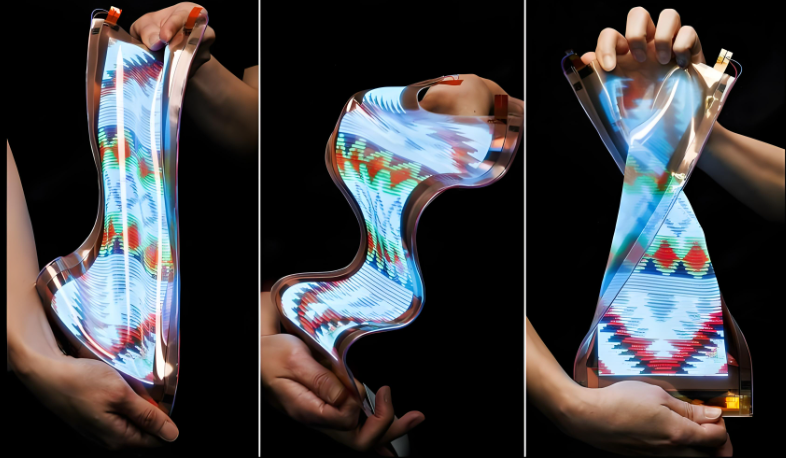
Recently, overseas universities have made two breakthrough research achievements in the OLED field. A joint team from the University of St Andrews and the University of Cambridge broke the world record for the fastest OLED communication, achieving 4 Gbps data transmission over a distance of 2 meters. Meanwhile, Kaunas University of Technology (KTU) in Lithuania, in collaboration with Ukrainian scientists, developed new OLED light-emitting materials.
OLED Communication Technology Sets New Record with 4 Gbps Transmission Rate
According to foreign media reports, Professor Ifor Samuel and Professor Graham Turnbull from the University of St Andrews, UK, in collaboration with Professor Harald Haas's team from the University of Cambridge, achieved a 4 Gbps transmission rate over a 2-meter distance using a single OLED device. This marks a 25% improvement over last year's record of 3.2 Gbps. Researchers significantly boosted the device's modulation bandwidth by redesigning the OLED stack and precisely selecting organic materials.
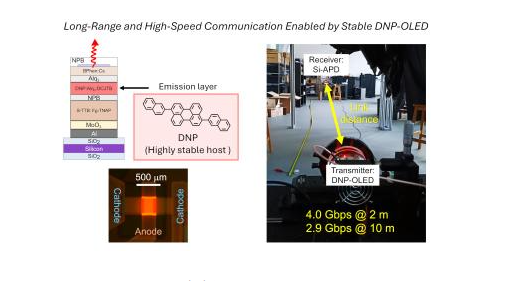
Notably, the team maintained an effective rate of 2.9 Gbps (with a bit error rate of 5.54×10⁻³) over a 10-meter link, with an actual encoded rate of 2.7 Gbps, extending the previous single-OLED transmission distance record by 40 times. The paper highlights that the operational stability of OLED devices is crucial for achieving high-speed communication. As the display and lighting industries continue to iterate on stability, OLEDs are expected to unlock greater application potential in fields such as spectroscopy, wireless optical communication, and wearable sensing.
Lithuanian and Ukrainian Research Teams Develop New OLED Emitting Materials
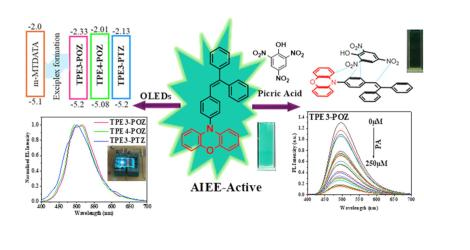
Recently, Kaunas University of Technology (KTU) in Lithuania, in collaboration with Ukrainian scientists, for the first time confirmed that complexes formed by two donor molecules can emit light efficiently, leading to the development of novel OLED emitting materials. Researchers synthesized three styrene-substituted phenoxazine and phenothiazine derivatives via Buchwald-Hartwig cross-coupling reactions. The study results demonstrated excellent hole mobility for these materials, particularly for derivatives containing tetraphenylethylene groups. OLED devices developed using these new materials emit blue light at a wavelength of 500 nm, with brightness exceeding 1000 cd/m2 and an external quantum efficiency (EQE) of 2.5%–6%.