Have you ever been captivated by those 3D images floating in mid-air, or virtual characters that seem almost within reach? When vendors tell you it's an "LED holographic screen," you might be completely confused: What's the principle behind it? Can it really achieve the "holographic projection" seen in movies?
Let's talk about a harsh truth: Most products on the market today called "LED holographic screens" are, strictly speaking, not true "holographic projections." True holographic projection is a technology based on the principles of light interference and diffraction, which records and reconstructs the 3D information of an object. It allows you to see different images from various angles, just like seeing a real object. That's some pretty advanced physics!
However, this doesn't stop these "holographic-like" LED display technologies from providing us with incredibly stunning visual experiences! They cleverly use visual deception or special display methods to simulate a 3D suspended effect, making it feel just like seeing a hologram.
So, what are the common types of technologies on the market that are generally referred to as "LED holographic screens" or can achieve similar "holographic" effects?
Type 1: The Most Common "Pseudo-Hologram" – LED Holographic Fan Display (LED Holographic Fan)
When you see an object rotating in the air, with images seemingly floating in mid-air, and you can view them from different angles, there's a good chance it's an LED holographic fan display. It's currently very popular in shopping malls, exhibitions, and product launches.
How LED Holographic Fan Displays Work: The Magic of Persistence of Vision
It's essentially a high-speed rotating fan with LED light bars. These light bars are densely packed with LED beads. When the fan rotates at an extremely high speed (e.g., hundreds or even thousands of revolutions per minute), utilizing the "persistence of vision" effect in the human eye, the LED beads continuously light up and turn off during rotation, forming a continuous image in space. It's like drawing circles with a glow stick when you were a kid; if you do it fast enough, you see a complete circle.
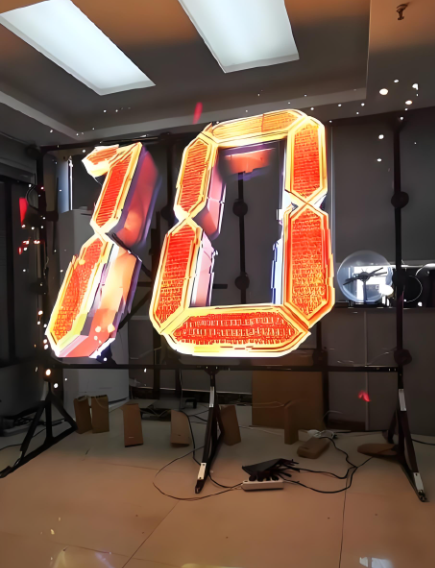
Because the light bars themselves are very thin, they become almost invisible when rotating, so you only see the image, as if it's "floating" there out of thin air, giving it a strong high-tech feel.
Features and Advantages of LED Holographic Fan Displays:
Outstanding Naked-Eye 3D Effect: See realistic 3D suspended images without wearing any special equipment.
Relatively Low Cost: Compared to other large 3D display technologies, the initial investment is more budget-friendly.
Flexible Installation: Compact in size, it can be hung individually or multiple units can be spliced together to form a larger display wall.
Easy Content Replacement: Easily upload and change display content via a mobile app or computer software.
High-Tech Appeal: The unique display method quickly grabs attention and enhances brand image.
Limitations of LED Holographic Fan Displays:
Limited Resolution: Since images are formed by rotating light bars, the image fidelity is not as high as traditional large LED screens.
Size Restrictions: Individual fans have limited sizes; large displays require multiple units to be spliced, and seams might affect the overall effect.
Primarily for Indoor Use: Brightness is usually insufficient to cope with strong direct sunlight, and the open structure is not suitable for harsh outdoor environments.
Safety Hazard: High-speed rotating blades pose a certain safety risk if not properly protected (hence they usually come with a transparent protective cover).
Common Application Scenarios for LED Holographic Fan Displays:
Commercial Displays: Shopping mall windows, product launches, brand counters, displaying items like jewelry, watches, shoes, and bags.
Exhibitions and Trade Shows: Attracting customers at booths, showcasing company logos and product animations.
Entertainment Venues: Bars, KTVs, theme parks, creating atmosphere.
Personal Creativity: Desktop ornaments, displaying personalized content.
Type 2: Eye-Catching Visual Deception – Naked-Eye 3D LED Display (Naked-Eye 3D LED Display)
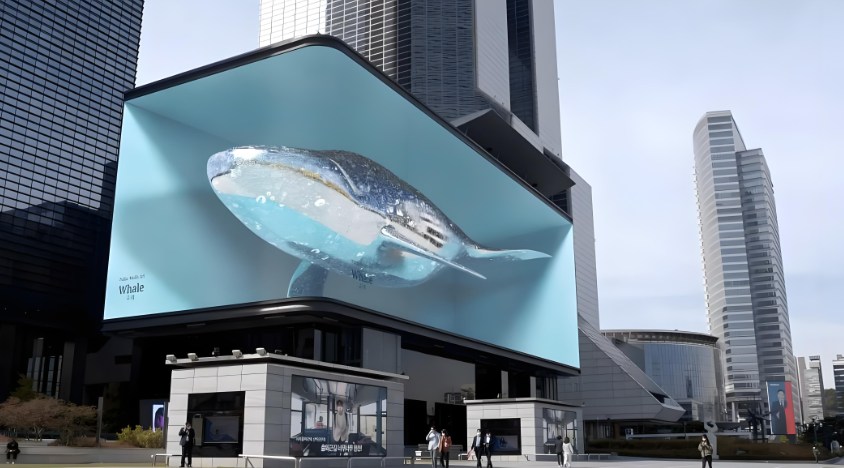
If you've ever seen a giant LED screen on a city street playing visuals that seem to "burst out" of the screen, even giving you a sense of depth, and you weren't wearing any 3D glasses, then congratulations, you've witnessed a Naked-Eye 3D LED Display!
How Naked-Eye 3D LED Displays Work: Visual Illusion from Specific Angles
This technology is not true holography; it utilizes the human eye's "visual illusion" and a special "parallax" principle. Simply put, through a special screen design (e.g., using screen corners, concave/convex surfaces) and specially produced 3D video content, the left and right eyes see slightly different images. When these images merge in the brain, they create a strong sense of three-dimensionality and depth, making it seem as if objects in the picture are truly protruding from or receding into the screen.
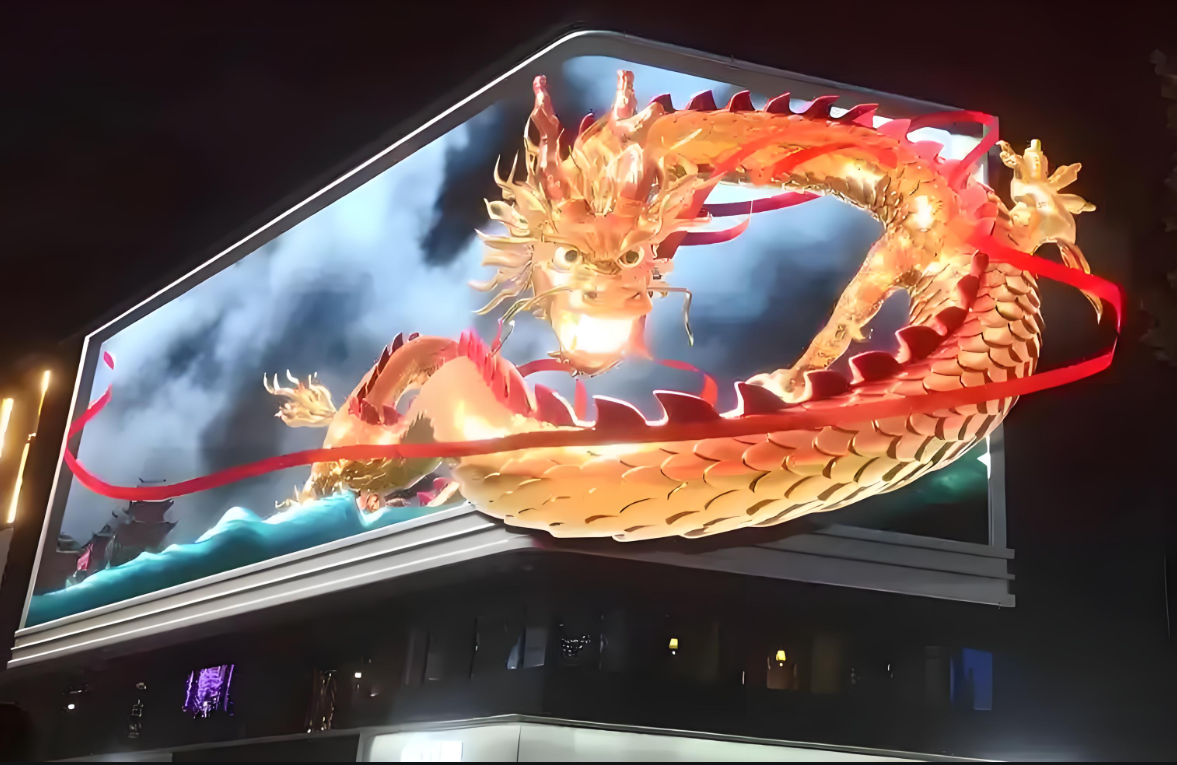
This type of screen usually requires specific viewing angles to achieve the best effect, and the video content must be meticulously designed and rendered to perfectly match the physical structure of the screen, thereby creating this realistic 3D illusion.
Features and Advantages of Naked-Eye 3D LED Displays:
Extremely Strong Visual Impact: Realistic and three-dimensional visuals instantly grab the attention of passersby, becoming a city landmark.
Massive Size: Typically composed of numerous standard LED modules spliced together, allowing for ultra-large displays.
High Brightness, High Definition: Suitable for outdoor use, ensuring clear display even in daylight.
Excellent Advertising Effect: The unique display method significantly enhances the reach and influence of advertising.
Strong Immersion: Combined with sound effects, it can create a very stunning immersive experience.
Limitations of Naked-Eye 3D LED Displays:
High Content Creation Costs: 3D video content requires a professional team for customized design and rendering based on the screen structure, which is time-consuming and labor-intensive.
Limited Viewing Angles: Although touted as "naked-eye 3D," the optimal viewing effect is usually concentrated in specific areas; viewing from off-angles may result in ghosting or distortion.
High Installation Costs: Often requires customized architectural structures to accommodate the screen's corners or curved designs.
Expensive: Both the screen itself and content creation involve high investment.
Common Application Scenarios for Naked-Eye 3D LED Displays:
City Landmarks: Outdoor advertising screens for large commercial complexes, city squares, and transportation hubs.
Brand Promotion: Product launches and experience centers for high-end brands like automobiles and tech products.
Culture and Tourism: Immersive experience zones in theme parks, tourist attractions, and museums.
Digital Art: Artists creating large-scale public art installations.
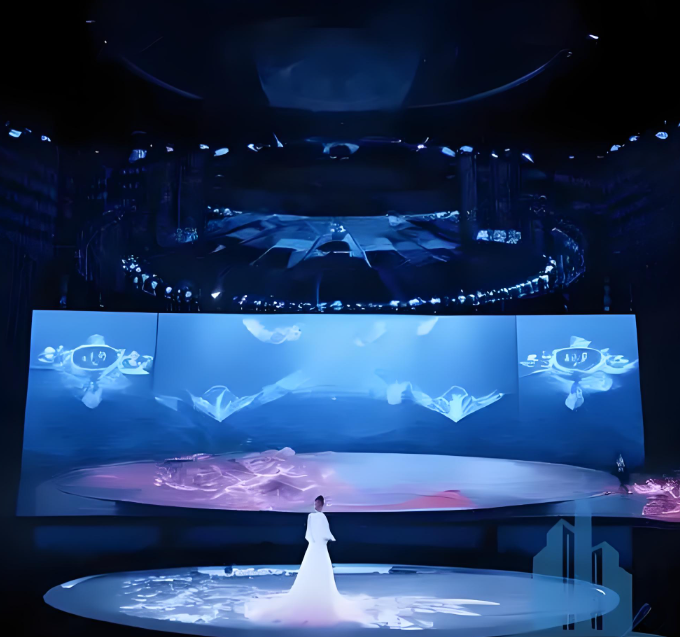
Type 3: The Stage Magician's Secret Weapon – Holographic Projection Film and Gauze Screen Projection (Holographic Projection Film/Gauze Screen Projection)
This technology operates on a completely different principle from the previous two LED screens. It's not a "screen" but rather a transparent or semi-transparent medium onto which images are projected, thereby creating an "illusory" 3D effect.
How Holographic Projection Film and Gauze Screen Projection Work: Combining Light Penetration and Reflection
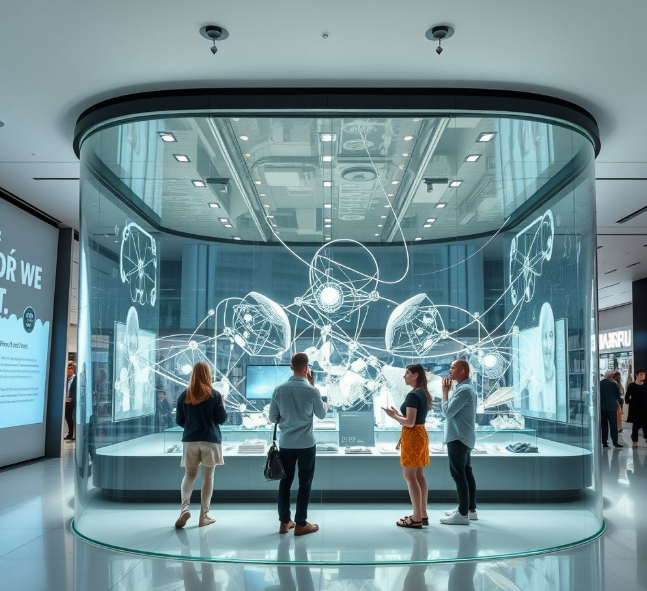
Holographic Projection Film: This is a special transparent film applied to glass or acrylic panels. When a projector casts an image onto the film from the back or front, due to the film's special coating, some light is reflected, forming a clear image, while other light passes through, keeping the background visible. This way, you see an image floating on a transparent medium, as if suspended in air.
Gauze Screen Projection: A gauze screen is a special, very fine white or gray mesh fabric that is lightweight and translucent. When a projector casts an image onto the gauze screen, due to its translucency, the audience can see the scene or people behind it. At the same time, the gauze screen effectively carries the projected image, creating an ethereal, dreamlike "ghost" effect.
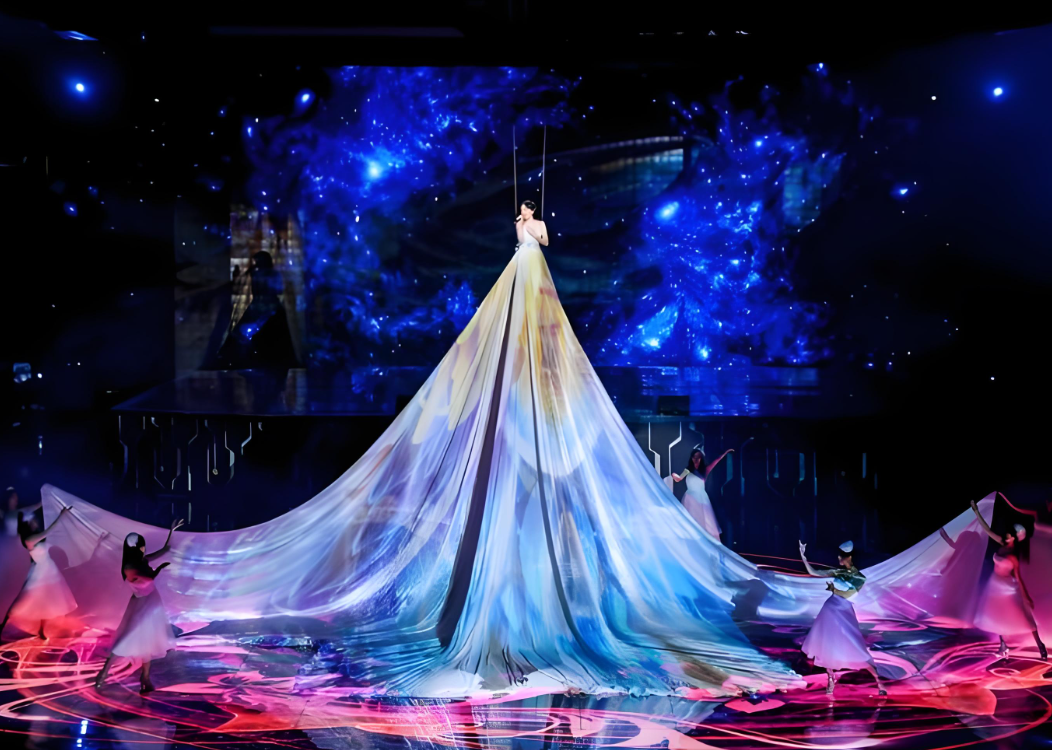
Features and Advantages of Holographic Projection Film and Gauze Screen Projection:
"True" Suspended Feel: Images merge with the real scene, allowing for interaction between virtual and real characters, creating a highly realistic effect.
Good Transparency: Does not obstruct the background view, suitable for stages, exhibition halls, and other scenarios requiring a sense of space.
Strong Interactivity: Combined with motion-sensing equipment, it can achieve audience interaction with virtual images.
Wide Application: Stage performances, museums, science and technology museums, product launches, etc.
Limitations of Holographic Projection Film and Gauze Screen Projection:
High Ambient Light Requirements: Requires a relatively dark environment for the best effect; bright light will affect image clarity.
Resolution Limited by Projector: Image quality depends on the projector's performance.
Complex Content Creation: Requires consideration of perspective, scene integration, etc., demanding high-level content production.
Non-Self-Emitting: Typically lower brightness compared to LED screens.
Common Application Scenarios for Holographic Projection Film and Gauze Screen Projection:
Stage Performances: Concerts, plays, operas, enabling virtual characters to appear and scenes to transform.
Museums/Science and Technology Museums: Displaying historical figures, artifact reconstructions, scientific principles.
Product Launches: Car launches, new product displays, making products appear "out of thin air."
Exhibitions and Displays: Brand showrooms, corporate exhibition halls, creating immersive experiences.
Comparison Table of Various "Holographic" Display Technologies: How to Choose the Right Solution for You?
To give you a more intuitive understanding of these technologies, I've prepared a detailed comparison table. Through it, you can clearly see their differences in principle, effect, cost, and application, helping you make the most suitable choice for your needs.
| 特性 (Feature) | LED全息风扇屏 (Holographic Fan) | 裸眼3D LED显示屏 (Naked-Eye 3D LED) | 全息投影膜/纱幕 (Holographic Projection) |
|---|---|---|---|
| Display Principle | Persistence of vision, imaging with high-speed rotating LED light bars | Visual illusion, specific screen + customized 3D video content | Projector light cast onto transparent/semi-transparent medium |
| 3D Effect Realism | Good, strong sense of floating image, viewable from multiple angles | Excellent, strong sense of depth and impact, best effect from specific angles | Excellent, can integrate and interact with real scenes, blending virtual and real |
| Brightness | Medium to low (suitable for indoor or dim environments) | Very high (suitable for strong outdoor light environments) | Low (depends on projector, requires dark environment) |
| Resolution | Medium (limited by light bar density and size) | Very high (depends on LED pixel pitch) | Medium (depends on projector resolution) |
| Applicable Scenarios | Shopping malls, exhibitions, product launches, small creative displays | City landmarks, large outdoor advertising, commercial complexes, brand stores | Stages, museums, science and technology museums, product launches, corporate exhibition halls |
| Content Creation Difficulty | Medium (requires professional 3D animation production) | Very high (requires customization based on screen structure, complex rendering) | High (requires consideration of perspective, scene integration, interaction with real people) |
| Cost Investment | Low-Medium | High-Very High | Medium-High (equipment + content production) |
| Interactivity | No (primarily one-way display) | No (primarily one-way display) | Yes (can be achieved with motion-sensing equipment) |
| Environmental Requirements | Indoor, avoid direct sunlight, requires protective cover | Outdoor/Indoor, requires specific building structures | Indoor, requires dark ambient light, specific background setup |
How to Choose the Right "Holographic" Display Solution for You? – Deeply Consider Your Needs
Now that you understand the main types of "holographic" display technologies on the market, how do you decide which one best suits your needs?
Clarify Your Core Needs and Budget:
What display size do you need? Is it a cool desktop gadget, or a breathtaking outdoor giant screen?
What is your budget? Prices vary wildly from a few hundred to several million yuan for different solutions.
Who is your target audience? Are you trying to attract passersby, or add a high-tech touch to a specific event?
Consider Installation Environment and Space Constraints:
Is it indoor or outdoor? Outdoor environments require high brightness, dustproof, and waterproof equipment.
How much installation space is available? Naked-eye 3D large screens need huge walls or corners, while holographic fan displays are more flexible.
Are there specific ambient light requirements? Projection-based technologies have higher demands for ambient light.
Evaluate Content Creation Complexity and Cost:
Do you have a professional 3D content creation team? Content creation for naked-eye 3D and holographic projection is highly specialized and expensive.
How often will the content be updated? Frequent content updates will increase ongoing investment.
What Kind of "Holographic" Effect Are You Looking For?
Want the most intuitive suspended effect and cost-effectiveness? Choose an LED holographic fan display.
Want the most stunning visual impact to create a city landmark? Choose a Naked-Eye 3D LED display.
Want to blend virtual and real, achieving a magical interactive effect for a stage? Choose holographic projection film or gauze screen projection.
Remember, there's no single "best holographic screen," only the "holographic" solution that's best for you!
Future Outlook for "Holographic" Display Technology: More Than Just Cool
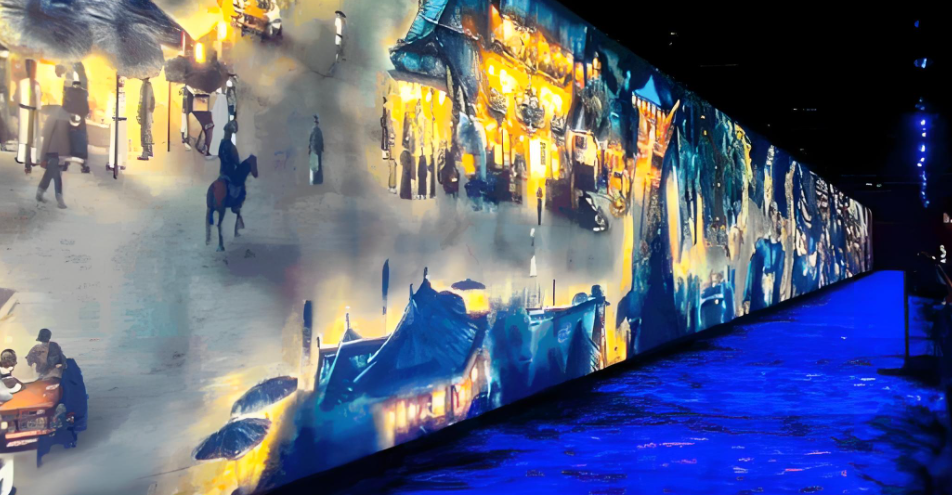
With continuous technological advancements, these "holographic-like" display technologies are also rapidly evolving:
Higher Definition, More Realistic: LED pixel pitch is becoming smaller, resolutions are getting higher, and 3D effects will become even more delicate.
Smarter, More Interactive: Combining technologies like AI, sensors, and 5G, future displays will not only play content but also interact with audiences in real-time, such as gesture control and voice recognition.
Broader Application Scenarios: Beyond commercial advertising and entertainment, they will be increasingly applied in fields like education, healthcare, and industrial design, offering more intuitive and immersive experiences.
True Holographic Technology: While not yet widespread, scientists continue their research in optical holography, computational holography, and other areas. Perhaps in the not-too-distant future, we will truly see the "real holography" from movies—touchable and viewable from multiple angles—enter our lives.
Frequently Asked Questions
You might still have some questions about "LED holographic screens." Here are some common FAQs:
Q1: Can LED holographic screens actually be touched?A1: No, they cannot. Whether it's an LED holographic fan display, a naked-eye 3D LED display, or holographic projection, they all create images using light. They are essentially light and shadow effects, with no physical substance. Therefore, you cannot touch the images they display. If you touch a holographic fan display, you'd be touching high-speed rotating blades, which is very dangerous!
Q2: Is content creation for these "holographic" displays difficult?A2: Relatively speaking, yes. They all require professional 3D animation production and rendering techniques. Among them, content creation for naked-eye 3D LED displays is the most challenging, requiring precise modeling and rendering based on the screen's physical structure; holographic fan display content creation is relatively simpler but still needs professional 3D animation; holographic projection content creation must consider integration with real scenes.
Q3: Is it expensive to install these "holographic" displays?A3: Prices vary greatly. LED holographic fan displays are relatively affordable, ranging from a few hundred to several thousand yuan; naked-eye 3D LED displays and large holographic projection systems are very expensive, potentially costing hundreds of thousands or even millions of yuan, mainly depending on screen size, resolution, content customization, and installation complexity.
Q4: Can "holographic screens" be used outdoors?A4: Naked-eye 3D LED displays are very suitable for outdoor use because they are highly bright and usually feature waterproof and dustproof functions. LED holographic fan displays are not suitable for long-term outdoor use due to lower brightness and lack of adequate protection. Holographic projection, requiring specific ambient light conditions, is not suitable for outdoor daytime use.
Q5: Is maintenance for these "holographic" displays troublesome?A5: Compared to traditional flat displays, it might be slightly more complex. LED holographic fan displays require regular cleaning of dust from the fan blades and care to avoid physical impact. Naked-eye 3D LED displays and holographic projection systems require professional maintenance teams for regular inspections and troubleshooting.
In Summary
Alright, by now you should have a clear understanding of the types and principles behind various "LED holographic screens" on the market.
LED Holographic Fan Display: Creates floating 3D effects through high-speed rotation and persistence of vision, offering good value for money, suitable for small displays.
Naked-Eye 3D LED Display: Uses visual illusion and specific content to create a powerful sense of depth, a top choice for outdoor advertising and city landmarks, but with high costs.
Holographic Projection Film/Gauze Screen Projection: Achieves magical effects that blend virtual and real through projectors and transparent media, often used for stages and exhibitions.
While none of them are true physical holograms, they all deliver unprecedented visual amazement in their unique ways. When choosing, it's most important to weigh your specific needs, budget, and application scenarios.
I hope this article helps you overcome your confusion about "LED holographic screens"!