Are you confused by the names "LED holographic screen" and "LED crystal film screen"? Don't worry, you're not alone! The market is flooded with all sorts of high-tech displays, and while their names sound cool, it's really not easy to figure out their unique "specialties" and "characteristics."
Today, we're going to do a complete "screen reveal" to help you understand LED holographic screens and LED crystal film screens inside and out. That way, next time you encounter them, you'll be able to see through them at a glance and easily make the best choice for your needs!
I. Unveiling LED Holographic Screens: The Future Window of Naked-Eye 3D
Have you ever seen scenes in sci-fi movies where characters interact with a virtual 3D image floating in the air? Exactly, LED holographic screens aim for this very effect! They strive for an immersive "naked-eye 3D" visual experience.
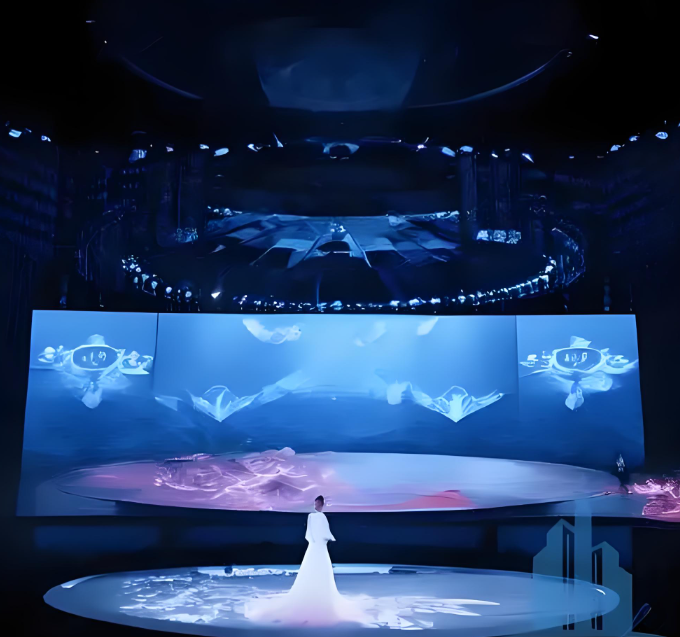
Simply put, LED holographic screens are not "holographic projections" in the traditional sense. They primarily utilize the principle of human visual persistence, along with light refraction and scattering technologies. By using high-speed rotating LED light bars or special screen structures, they create three-dimensional, floating images in the air, making you feel as if the image is truly suspended right in front of you, tangible yet untouchable.
1.1 Working Principle and Features of LED Holographic Screens
Imaging Principle: The most common LED holographic screens, especially what we often call "holographic fan screens," create continuous images in the air by rapidly rotating LED light bars, leveraging the visual persistence effect of the human eye. Other larger LED holographic screens may achieve naked-eye 3D effects through special pixel arrangements and light control, giving the image depth and three-dimensionality, as if truly "jumping" out of the screen. This is distinctly different from traditional 2D flat displays.
Visual Effects: The biggest characteristic is their immersive and high-tech feel. They can present realistic stereoscopic images, allowing viewers to experience the sensation of floating and penetrating images without wearing any 3D glasses. Imagine a product model or a virtual character appearing "live" right before your eyes – how cool is that?
Transparency: Strictly speaking, LED holographic screens are not completely transparent. Their "transparency" refers more to their ability to "create" images in the air, with the background being relatively blurred or inconspicuous, giving the illusion that the image is independent of the medium. The physical body (e.g., fan blades) becomes less noticeable when rotating at high speed, thus achieving a "transparent imaging" effect.
1.2 Advantages and Disadvantages of LED Holographic Screens
Advantages:
Ultimate Visual Impact: Naked-eye 3D effects instantly grab attention, delivering a stunning immersive experience.
High-Tech Feel: Enhances brand image and showcases technological strength, ideal for innovative displays.
Strong Interactivity: Combined with body sensing, gesture recognition, and other technologies, it can achieve richer interactive experiences.
Disadvantages:
High Content Production Cost: Naked-eye 3D content requires specialized team customization, with long production cycles and high costs.
Limited Viewing Angle: Although naked-eye 3D, the best effect is usually achieved from specific angles; deviating from these angles may affect the stereoscopic perception.
Brightness and Clarity: Compared to traditional LED screens, performance may be poor in strong light environments, and resolution has certain limitations.
Installation Environment Requirements: Certain requirements for ambient light and space are needed to ensure optimal display effects.
1.3 Typical Application Scenarios for LED Holographic Screens
LED holographic screens shine in the following areas with their unique visual charm:
Stage Performances: Used as stage backgrounds or props, creating fantastical scenes that blend virtual and real elements, making the audience feel immersed.
Exhibitions and Displays: Museums, science and technology museums, auto shows, new product launches, etc., used to display product details, virtual models, historical scenes, bringing a brand new viewing experience. For example, you can see a virtual car "spinning" in front of you at an exhibition, or even "disassembling" to show its internal structure.
Commercial Advertising: Shopping mall atriums, brand flagship stores, attracting customers to stop and watch, enhancing brand image and sales.
Science and Education Fields: Teaching simulations in biology, medicine, geography, making abstract concepts concrete and visual.
II. Exploring LED Crystal Film Screens: A New Revolution in Transparent Displays
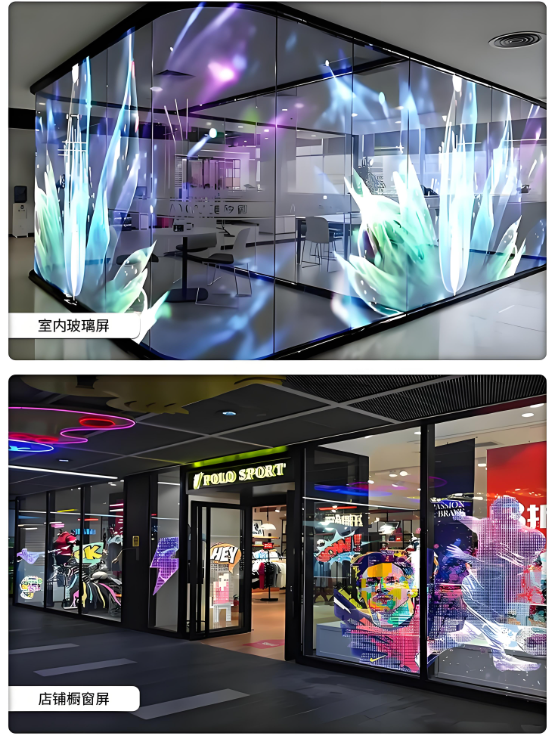
Unlike LED holographic screens, which pursue "illusory three-dimensionality," LED crystal film screens focus on "transparent display." Their biggest features are being thin, light, and transparent, allowing them to be affixed to glass like a film. This enables the screen to display content while also clearly showing the view behind it.
Imagine your floor-to-ceiling window suddenly being able to play movies, but when you turn the movie off, it reverts to ordinary transparent glass. Isn't that magical? That's the charm of LED crystal film screens!
2.1 Working Principle and Features of LED Crystal Film Screens
Imaging Principle: LED crystal film screens utilize special chip packaging technology and SMT processes to directly attach LED lamp beads onto highly transparent PCB boards or PET substrates, forming a dot matrix. When the screen is off, due to its extremely high transparency rate (usually 70%~95%), the screen itself is almost invisible to the naked eye, appearing like transparent glass. When lit, the LED lamp beads emit light, forming images. It is a self-luminous display technology, where content is directly presented on a transparent medium, rather than "floating" in the air.
Visual Effects: The biggest feature is high transparency; even when playing content, objects behind the screen can still be seen. It perfectly blends digital content with the physical environment, creating a unique "virtual and real combination" visual effect. Content appears to float on the glass, full of technological flair, without obstructing the view.
Form Factor Characteristics:
Ultra-thin and Lightweight: Typically only a few millimeters thick and extremely light, adding almost no structural load to buildings.
High Transparency: Extremely high transparency rate, not affecting natural lighting and sightlines.
Flexible and Bendable: Some crystal film screens possess flexible characteristics and can conform to curved glass or irregular structures.
Easy Installation: Applied directly to the glass surface like a film, eliminating the need for complex steel structures, making installation convenient.
2.2 Advantages and Disadvantages of LED Crystal Film Screens
Advantages:
High Transparency: Maintains the original lighting and landscape transparency of the building, without obstructing indoor or outdoor views.
Easy Installation: No need to damage existing structures; direct adhesion significantly shortens construction periods.
Thin, Light, and Aesthetic: Almost invisible, saves space, perfectly integrates into modern architectural design.
Energy-Saving and Eco-Friendly: Compared to traditional LED screens, it consumes almost no power when displaying black (transparent) content.
Wide Application: Suitable for various glass curtain walls, showcases, and other scenarios.
Disadvantages:
Pixel Density Limitations: To ensure high transparency, pixel pitch is usually larger, resulting in lower resolution compared to traditional LED screens, making it unsuitable for close-up viewing of high-definition images.
Viewing Angle: From certain angles, the outline of LED lamp beads might be visible, affecting the transparent effect.
Content Display: More suitable for displaying simple content like text, lines, animations, rather than large areas of solid-color images (which would reduce transparency).
Maintenance: Although easy to install, if a single lamp bead is damaged, professional tools may be required for repair or replacement.
2.3 Typical Application Scenarios for LED Crystal Film Screens
LED crystal film screens excel in the following scenarios due to their unique transparent characteristics:
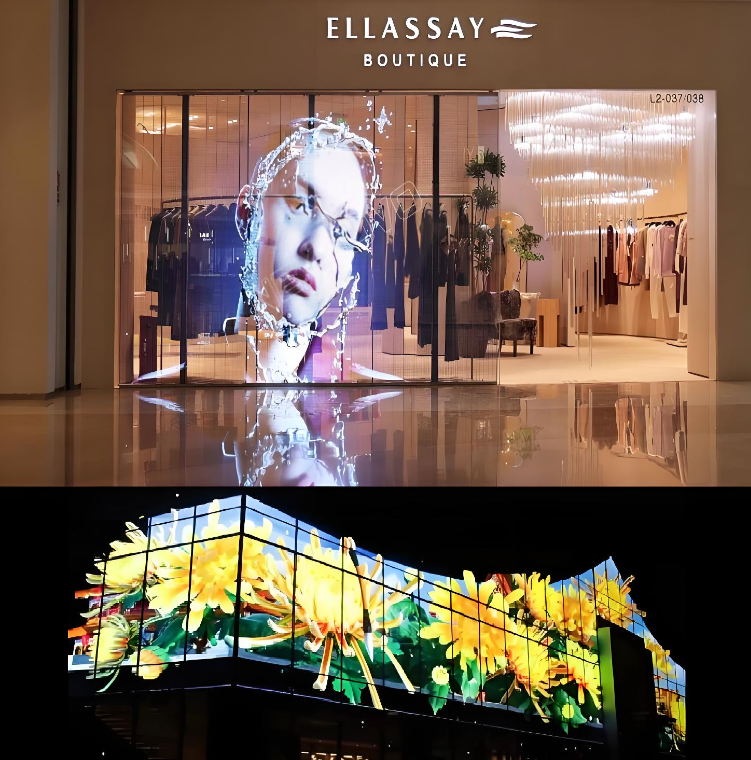
Glass Curtain Wall Displays: Commercial buildings, shopping centers, hotels, car 4S stores, etc., turning building facades into giant advertising screens or landscape displays without affecting indoor lighting.
Commercial Showcases: Retail stores, jewelry shops, banks, etc., displaying product information and promotional advertisements on showcases, attracting customers while allowing them to see store displays through the screen.
Exhibitions and Displays: Museums, tech exhibitions, art galleries, serving as exhibit backgrounds or information carriers, achieving a blend of virtual and real display effects.
Interior Space Design: Office partitions, conference room glass walls, elevator shafts, etc., displaying information while maintaining spatial transparency.
Transportation Hubs: Glass passages or waiting areas in airports, train stations, and subway stations, used for displaying flight, train information, or advertisements.
III. Core Differences Unveiled: Key Distinctions Between LED Holographic Screens and LED Crystal Film Screens
By now, you should have a preliminary understanding of these two types of screens. It's time for an "ultimate showdown" to break down their core differences for you!
3.1 Imaging Principle: Illusory Floating vs. Real Transparency
LED Holographic Screen: Emphasizes "aerial imaging" or "naked-eye 3D." It uses special optical principles or high-speed rotation to create a three-dimensional effect in the air, giving the illusion that the image is "floating." Essentially, it creates a virtual 3D space.
LED Crystal Film Screen: Emphasizes "self-luminous display on a transparent medium." It is itself a transparent display screen, with LED lamp beads directly emitting light on a transparent substrate to form images. The background is genuinely transparent, allowing objects behind the screen to be seen.
3.2 Visual Effects: Stunning 3D vs. Integrated Transparency
LED Holographic Screen: Pursues ultimate visual impact and immersion, with strong stereoscopic images that feel almost tangible, delivering a breathtaking "wow" experience.
LED Crystal Film Screen: Pursues harmonious integration with the environment, maintaining spatial transparency while displaying content, creating a high-tech feel of "invisible yet present." It focuses more on information transmission and environmental aesthetics.
3.3 Transparency Performance: Visual Illusion vs. Physical Transparency
LED Holographic Screen: Its "transparency" is a visual illusion, achieved by making the physical body inconspicuous through high-speed rotation or special technology, thus creating the effect of images "floating." It is not a transparent panel itself.
LED Crystal Film Screen: Possesses real physical transparency; its substrate and circuitry are transparent, allowing light to pass through. Therefore, when not displaying content, it acts like a transparent glass.
3.4 Installation Method and Flexibility: Fixed Structure vs. Flexible Adhesion
LED Holographic Screen: Typically requires specific installation structures (e.g., fan brackets, cabinet structures), with relatively fixed installation positions and certain space requirements.
LED Crystal Film Screen: Its biggest features are its thinness, flexibility (for some products), and ease of adhesion. It can be directly affixed to glass surfaces without large steel structures, making installation very convenient, and can even conform to curved glass.
3.5 Application Scenario Focus: Artistic Display vs. Architectural Integration
LED Holographic Screen: Focuses more on high-tech, artistic, and immersive displays, often used in stages, exhibitions, new product launches, and other occasions that require creating a sensational effect.
LED Crystal Film Screen: Focuses more on architectural aesthetics, information dissemination, and commercial advertising integrated with the environment, often used in glass curtain walls, shopping mall showcases, exhibition halls, and other scenarios that require both display and natural lighting.
3.6 Cost and Maintenance: Content is Key vs. Screen Body is Key
LED Holographic Screen: Besides the cost of the screen itself, the cost of naked-eye 3D content production is often a larger expense. The higher the degree of content customization, the higher the cost. Maintenance may involve the upkeep of rotating parts or complex optical systems.
LED Crystal Film Screen: The cost of the screen itself is the main part, and content production is relatively simple, using ordinary 2D videos or images. Maintenance primarily involves the repair or replacement of lamp beads.
IV. Data Comparison Table: Differences at a Glance!
To help you understand their differences more intuitively, I've prepared a detailed comparison table for you:
| Feature Dimension | LED Holographic Screen (Representative Products: Holographic Fan Screen / Naked-Eye 3D Screen) | LED Crystal Film Screen (Representative Products: Transparent Adhesive Film Screen / Glass Curtain Wall Screen) |
|---|---|---|
| Imaging Principle | Utilizes visual persistence or special optical structures to form virtual stereoscopic images in the air. | LED lamp beads self-illuminate on a transparent substrate, directly displaying images on the transparent medium. |
| Visual Effects | Naked-eye 3D, strong stereoscopic effect, immersive, floating image sensation, with a sense of penetration. | High transparency, image blends with background, content floats on glass, does not obstruct view. |
| Transparency | "Transparency" in a visual sense; the physical body is relatively invisible when rotating at high speed or not displaying. | Physical high transparency, 70%~95% transmittance, light can pass through. |
| Product Form | Exposed LED light bar fan blades, special cabinet structures, customized screens. | Ultra-thin, lightweight, flexible (some), can be directly affixed to glass surfaces, like a film. |
| Installation Method | Requires fixed brackets or cabinet structures, with requirements for installation space and environment. | Directly adheres to glass surfaces, no steel structure needed, easy installation, can conform to curves. |
| Flexibility | Mainly reflected in the creativity of content production; screen structure is relatively fixed. | Flexible and bendable (some), can be cut, adapts to various irregularly shaped glass. |
| Main Applications | Stage performances, product launch events, exhibitions and displays, commercial showcases (small-scale), science museums, digital art. | Glass curtain walls, shopping mall showcases, indoor partitions, exhibition hall glass, landscape lighting, transportation hubs. |
| Content Requirements | Requires customized naked-eye 3D content, high production cost, long cycle. | 2D video, images, text, etc.; content production is relatively simple, but needs to consider adaptability to transparent backgrounds. |
| Cost | Higher screen body cost, even higher cost for naked-eye 3D content production. | Screen body cost is relatively high, but content production cost is lower. |
| Maintenance | Complex components may require professional maintenance; content updates require re-creation or adjustment. | Modular design, local repair of damaged lamp beads possible, convenient content updates. |
| Typical Representatives | Holographic fan screens, naked-eye 3D LED display screens | LED transparent adhesive film screens, LED glass curtain wall screens |
V. How to Choose the Right Transparent Display Solution for You?
Having read this far, you should have a general idea in mind. So, how exactly should you choose? Don't worry, let's help you organize your thoughts:
Clarify Your Core Needs and Goals:
Seeking a stunning naked-eye 3D effect? Want to make products or characters "come alive" and bring a strong visual impact and immersive experience to the audience? Then an LED holographic screen is your top choice. It can create sci-fi movie-like scenes and is a powerful "eye-catcher."
Need a transparent display that can play content without affecting natural light and views? Hope to integrate display functions into architectural or space design, balancing aesthetics and practicality? Then an LED crystal film screen is your ideal choice. It can turn your glass into an information carrier while maintaining transparency.
Consider Your Budget:
The overall investment for an LED holographic screen, especially in terms of content production, can be quite high. If your budget is ample and you have extremely high demands for the effect, you can consider it.
The screen body cost of an LED crystal film screen is not low, but content production is relatively flexible and cheaper. If your budget is relatively limited, or content updates are frequent, a crystal film screen might offer better value for money.
Evaluate Installation Environment and Conditions:
LED holographic screens usually require a certain amount of space and fixed installation structures, as well as requirements for ambient light to ensure the best 3D effect.
LED crystal film screens have relatively relaxed installation environment requirements; they can be simply adhered to any flat glass surface, making them very suitable for glass curtain walls, showcases, and similar scenarios.
Think About Content Presentation Format:
If you want to display complex 3D models, virtual characters, or artistic works requiring high immersion, an LED holographic screen is the best medium.
If you primarily want to display text, lines, simple animations, product images, or videos on transparent glass without obstructing the background, an LED crystal film screen is very suitable.
Pro Tip: Before making a final decision, it's best to personally experience the actual effects of both types of screens, or consult with professional display solution providers. They can provide more precise recommendations based on your specific needs.
VI. LED Screen FAQs: Helping You Understand Completely!
Q1: Can LED holographic screens and LED crystal film screens replace each other?A1: No, they cannot. Their design philosophies, technical principles, and core functions are completely different. LED holographic screens focus on creating 3D virtual images, while LED crystal film screens focus on displaying information on a transparent medium while maintaining transparency. Their application scenarios also differ significantly as a result.
Q2: Which one is more expensive?A2: It's hard to generalize. In terms of the screen body itself, both high-end LED holographic screens and crystal film screens are relatively expensive. However, if you include content production costs, the overall investment for LED holographic screens (especially for naked-eye 3D content) is usually higher, as 3D content creation is very specialized and time-consuming. The content production cost for LED crystal film screens is relatively lower.
Q3: Are they complicated to install?A3: LED crystal film screens are relatively simple to install because they are usually directly adhered to glass, like a film, and do not require complex steel structures. LED holographic screens (especially large ones) may require custom brackets or cabinet structures, making installation relatively more complex.
Q4: Which one is more troublesome to maintain?A4: This depends on the specific product and technology. Generally, LED holographic fan screens, due to their high-speed rotating components, may require regular inspection and maintenance. Maintenance for LED crystal film screens primarily focuses on the repair or replacement of lamp beads; due to their flexible nature, localized maintenance might require specific skills.
Q5: Besides these two, are there other similar transparent display screens?A5: Absolutely! The market also offers:
LED Transparent Screens (Grille Screens / Strip Screens): These have larger pixel pitches, creating a hollow effect, and can also achieve high transparency, but are typically thicker and heavier than crystal film screens.
LED Glass Screens: LED lamp beads are directly embedded into laminated glass, forming a dot matrix display. They offer high transparency, are robust and durable, but are usually not bendable and come at a higher cost. These products also have their unique application scenarios and advantages.
Alright, friend, after this in-depth discussion, I believe you now have a clear understanding of LED holographic screens and LED crystal film screens.
The LED holographic screen is like a magician, adept at conjuring astonishing 3D images in the air, bringing you the ultimate visual shock and immersive experience. If you want to create a sensation and capture everyone's attention, it's your go-to choice.
The LED crystal film screen, on the other hand, is like an invisible artist. It subtly integrates display functions into glass, revitalizing your glass curtain walls and showcases without obstructing light or views. If you're seeking a perfect blend of technology and aesthetics, hoping information can seamlessly appear in your transparent space, then it's your ideal partner.
Remember, there's no single "best" screen, only the one that's best for you. When making your choice, always let your core needs, budget, and actual application scenarios be your compass. I hope today's sharing helps you clear the fog and find the "window to the future" that's perfect for you!
If you have any further questions or need more specific solution recommendations, feel free to consult with professionals. They will tailor the most suitable display solution for you based on your actual situation. Good luck!